A few of my favorite science and nature documentaries

Here’s a list of science and nature documentaries that have made an impression on me over the years and continue to be a source of inspiration as I create my own body of work. If you think I’ve missed an awesome movie or three let me know in the comments.
Death by Design:Where Parallel Worlds Meet (Friedman/sBrunet, 1995)
This is a documentary about apoptosis–a.k.a. programmed cell death; a topic most documentary producers wouldn’t touch with a very long stick. But it’s artfully pulled off by Jean-Francois Brunet and Peter Friedman (a microbiologist and film director, respectively) by blending archival footage of Hollywood musicals with microcinematography of cells committing suicide.
The Blue Planet Series (BBC/Discovery, 2001)
The best series on ocean life ever; both for it’s broad scope and magnificent cinematography. If you get the series on DVD be sure to check out the supplemental disc “Deep Trouble” that highlights environmental threats to our oceans.
The Life of Mammals Series (BBC, 2002)
An expansive series on mammals great and small narrated by the illustrious Sir David Attenborough. Aside from the ace cinematography what amazes me about this series is how they stitched the whole thing together. One minute Sir David is in New Zealand telling us about the duckbill platypus; the next he’s standing on the African savanna explaining the feeding behavior of a bush baby. It takes great ingenuity and planning to create a seamless narrative like that; filming on different days, with different crews and across different continents.
Planet Earth (BBC/Discovery/NHK/CBC, 2006)
Aside from its sweeping vistas of our planet and never-before-scene shots of animals in nature, the stand out thing about this series is the jaw-dropping stop-motion footage of plants. The flora that covers our planet rarely serves as anything other than a backdrop for the charismatic megafauna that populate most nature docs. But in this series the secret world of plants is brought to the fore. Also of note: the scene of a parasitic fungus bursting through the head of an ant (also caught with stop motion).
The Science of Sex Appeal (Discovery, 2009)
I discovered this little gem searching around the streaming movies on Netflix. Simple, concrete illustrations of the on-going battle of the sexes.
Walking with Prehistoric Beasts (BBC/Discovery, 2001)
I was a huge fan of the “walking with” series when it first came out but the whole dinosaur theme got a bit played out. Then along came the prehistoric beasts chapter which explores the bizarre mammals, birds and other creatures that lived between the end of the dinosaurs and the dawn of humanity. Many of these creatures seem familiar, because they are ancestors of species that survive to this day. But it’s as if modern animals were re-imagined into horrific beasts from a cruel bizarro-world parallel to our own; see the andrewsarchus and entelodont featured in this doc.
The Botany of Desire (Schwarz, 2009)
A video recreation of Michael Pollan’s book Botany of Desire. In general, a solid film, but I would recommend you skim the section about tulips unless you are really, really into flowers.
King Corn (Mosaic Films, 2007)
Basically a video version of the first half of Michael Pollan’s second book, the Omnivore’s Dilemna. In Pollan’s book, he buys a steer and takes it all the way from field to slaughter house. In this movie the filmmakers use a similar plot device buying a plot of land to grow their own corn. Also of note: stop motion fun with Playmobil figurines that help illustrate more abstract concepts.
NOVA: Dogs Decoded (BBC/WGBH, 2010)
If you think a secret Soviet breeding program to domesticate foxes is cool–this movie is for you.
NOVA : The Great Robot Race (WGBH, 2006)
Documentary storytellers often talk about the “train” of their film. It’s the narrative line of the movie that pulls all the other parts along. In this case, the producers built the story around the DARPA Challenge, a car race sponsored by the research branch of the U.S. military. The twist is that these cars autonomously navigate the race course; a treacherous 130-mile trek through the Nevada desert. First car to the finish line nets two million dollars for the team that built it . That’s one helluva train!
The Cove (Psihoyos, 2009)
This 2009 Oscar-winner, in Mission Impossible style, follows environmental activists as they try to film the secret slaughter of dolphins along the East Coast of Japan. This movie appealed to me as an environmentalist, animal-lover and spy gadget geek.
Grizzly Man (Herzog, 2005)
A profile of activist Timothy Treadwell who anthropomorphized grizzly bears and was eventually killed and eaten by one. This is less a nature documentary than an essay on the perils of believing that nature has our best interests at heart. Treadwell was a skilled filmmaker in his own right and his beautifully-austere footage of the Alaskan wilderness complements Herzog’s storytelling.
March of the Penguins (Jacquet, 2005)
This nature doc grossed over $127 million worldwide, so I’m guessing most people reading this have seen it. So all I’ll say is this is a great film and one worth watching again…especially on a hot New York summer day when you want to fool your brain into thinking it’s cold out.
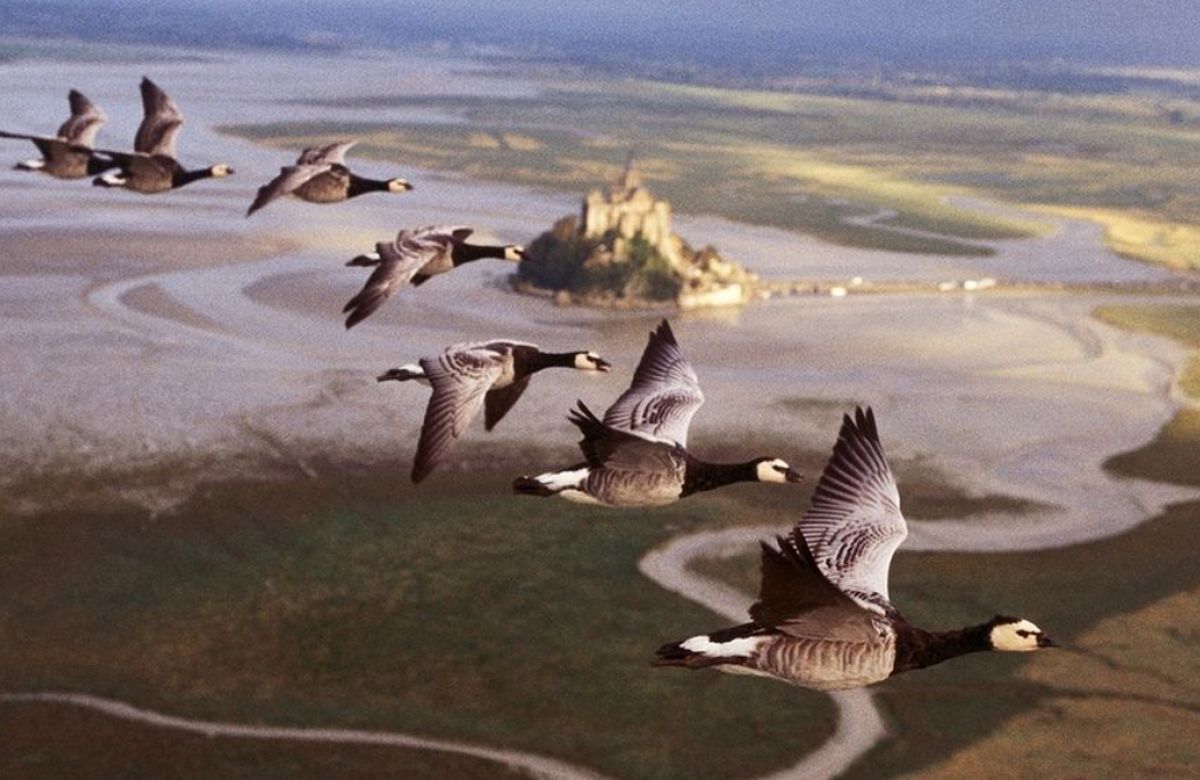
Winged Migration (Perrin/Cluzaud/Debats, 2001)
How they made this movie (included in the DVD extras) is as interesting as the film itself. One feature of bird behavior is that young chicks imprint on their mothers. That’s why you see a gaggle of baby geese waddling along behind their mother. The filmmakers exploited that behavior and tricked various species of migratory birds to imprint on human handlers. They put the handlers (and a camera) into an ultralight airplane and filmed the birds as they flew alongside their “mothers”. Wicked genius.
How the Earth was Made (History Channel, 2009)
Personally, I find geology a bit dry, especially as the subject of a film, but this series works because it shows us how our planet was created.
Bonus:
I watched these a while back and have forgotten why I like them so much. But I gave them five stars in my Netflix queue so I’d recommend checking them out.
Evolution (PBS, 2002)
Strange Days on Planet Earth (PBS, 2005)
NOVA: Cancer Warrior (WGBH, 2001)




A nice collection, although I never heard of a Death by Design…how you described it, it really seems very interesting…I will have to look at it.
Yeah, that’s kind of an obscure documentary and I’m not sure how I found out about it. Definitely original!